Camp 3 Photo Album               
|
The Camp 3 Timber Harvest Plan
Camp 3 has not been logged for over eighty years. If logged as CDF proposes, the complex redwood forest ecology now re-established in Camp 3 would not return for another 80 years -- even if not further disturbed. But under current and proposed management schemes of CDF, these areas will be entered and logged every ten to twenty years. There will be no chance for the forest to heal itself. We approached the new plan through areas that have been logged in the past 10 to 15 years. The road built for these prior logging operations is a disgrace and was probably illegal when built: it lacks waterbars, improperly drains inslope in places, and outslope drains go into sediment piles, and lacks proper rock on steep slopes (Photos 1, 2, 3). Improperly constructed and maintained, the road pours sediment every year into already degraded salmon streams. Staging areas contains piles of sediment and slash (Photos 4, 5). Invasive pampas grass has spread into openings left by heavy logging. (Photo 6). An occasional large tree has been left in "Seed Tree Management" areas (Photo 7). Standard practice is to come back and cut these ten years later (though CDF is promising to keep the few survivors in this area for future "structure elements"). There is no true forest left in these logged areas, only thin stands of trees (Photo 8). The Camp 3 plan area contrasts sharply with the adjacent logged areas. We walked through filtered sunlight, surrounded by huge trees, feeling the awe inspired by even the adolescents of the tallest trees on the planet (Photos 9-11). But, we were dismayed to see the blue paint rings around most of the biggest trees -- the rings that mark the trees for cutting (Photos 12,13). Throughout the planned harvest area, we found that most of the clusters of the biggest, most magnificent trees were slated to be entirely cut down. No survivors allowed! (Photos 14, 15). The Camp 3 logging plan comes right down to the flats of a major fork of the Noyo River, to an area heavily used by the public for recreation and education (a large group of local school children arrived here at the same time as we did). This part forest is magnificent (Photo 16), but if CDF's plan goes forward, it will be bordered by devastation. We left Camp 3 inspired by its beauty, horrified by the prospect of its destruction, and determined not to let it be destroyed here or elsewhere in Jackson State Forest. If you share our vision of preserving and restoring this incredible, publicly owned forest, please join our Campaign. 2021 Addendum Starting in June 2000, the Campaign filed a number of suits that succeeded in halting all logging in Jackson Forest, including in Brandon Gulch and Camp 3, until June 11, 2003. This was just one day after the Mendocino Superior Court refused to issue a preliminary injunction even though finding it very likely it would rule in our favor on our suit. On June 17, the Court Appeals issued a stay halting all logging. In just the six days when logging was allowed, 1500 trees were felled, primarily in Brandon Gulch, but also in Camp 3. CDF exhibited a disgraceful disrespect of its public trust duties when it allowed this logging. Logging did not resume until 2009, under very different terms imposed as part of a settlement between the Campaign and CDF. In a victory for the public, the Campaign forced CDF to establish a 158-acre preserve in Camp 3 and to lay out a recreation trail through Camp 3 before logging, so views from the trail through the logged portion would be protected. Typically, ten years later CDF has not built the recreation trail or informed the public of the existence of the preserve -- but the undisturbed stands in the preserve are there for future generations. The settlement also reduced the cut by two-thirds, adjacent recreation areas were protected, and the largest trees were preserved. These were concrete benefits obtained by the Campaign and its supporters. This is only a temporary victory. We, the owners of Jackson Forest, need to protect all of Jackson Forest from further destructive logging. Join the New Campaign to Restore Jackson State Redwood Forest.
|
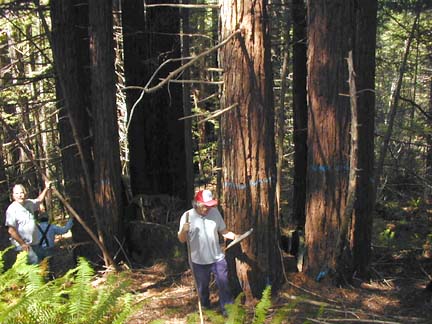 On May 25, 2000, the staff
of the Campaign to Restore Jackson State Redwood Forest visited the "Camp
3" Timber Harvest Plan (THP) -- one of the 3 plans submitted by CDF (as
managers of Jackson State Forest) to CDF (as administrators of the
state's Forest Practice rules) for approval. Camp 3 is in the
center of Jackson State Forest, northeast of the Egg Collecting Station
and in the most heavily used recreation area of the Forest.
On May 25, 2000, the staff
of the Campaign to Restore Jackson State Redwood Forest visited the "Camp
3" Timber Harvest Plan (THP) -- one of the 3 plans submitted by CDF (as
managers of Jackson State Forest) to CDF (as administrators of the
state's Forest Practice rules) for approval. Camp 3 is in the
center of Jackson State Forest, northeast of the Egg Collecting Station
and in the most heavily used recreation area of the Forest.