Campaign Succeeds in Modifying
Resolution On Jackson State Forest
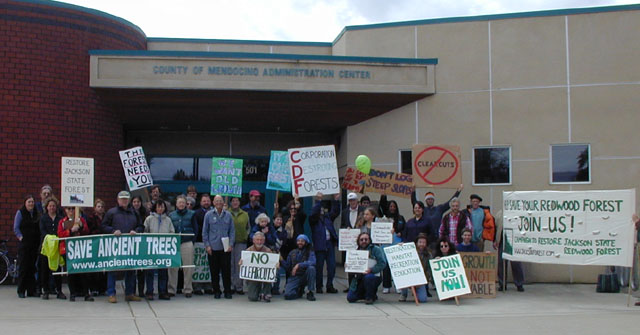 On March 12, the Mendocino Board of
Supervisors considered a resolution passed to it from the Mendocino
Forest Council. As passed by the Forest Council,
the resolution commended the California Department of Forestry (CDF)
for its past management of Jackson State Forest, supported future
large-scale logging, and urged resumption of logging as soon a possible.
The mills and logging companies were behind this resolution.
On March 12, the Mendocino Board of
Supervisors considered a resolution passed to it from the Mendocino
Forest Council. As passed by the Forest Council,
the resolution commended the California Department of Forestry (CDF)
for its past management of Jackson State Forest, supported future
large-scale logging, and urged resumption of logging as soon a possible.
The mills and logging companies were behind this resolution.
The Campaign fought against the resolution earlier at the Forest Council, gaining some important changes in language but failing to remove its emphasis on timber production to exclusion of all else. The Campaign mounted a major drive to alert the public and its members to the effort by the timber industry to get Mendocino County endorsement of future large-scale logging of our largest State Forest. The issue and the stakes were summarized in an article in the local newspaper.
Although the final numbers are not available, perhaps 500 or more letters, e-mails, and phone calls in support of restoration deluged the supervisors. Despite the location of the meeting, one and one-half hours away from the coast where most Campaign supporters live, between 60 and 75 turned up for the meeting. The timber industry, threatened by the first real challenge to their control of Jackson State, turned out an equal number of mill and logging company owners, foresters, and timber unionists.
In a prepared statement, Vince Taylor, Executive Director of the Campaign urged the Board not to take any position at that time on the future use of Jackson State Forest. He said, "Any position taken today would be without factual foundation and would deny the citizens of this county their right to be fully heard and counted." The Board failed to heed this sound advice.
At the end of almost four hours of testimony and Board debate, the Board passed a resolution significantly different from the one passed to it by the Forest Council. Although it did endorse future logging of Jackson State Forest, it also called for "balanced" consideration of recreation, wildlife, research and education. This was a small but real step toward recognizing that the public forest needs to be used for the benefit of all the people of California, not simply the local timber industry.
There were other positive results from the mobilization of support for restoration. For more on what was achieved, as well as details of the meeting, see Report to Members on the Outcome of the Meeting of the Board of Supervisors.
Failure of government
The Board failed to fully consider written public comments or to collect and evaluate in-depth information about the benefits of alternative futures for Jackson State. In failing to do both of these before voting on the resolution, the Board failed a basic tenant of good government: to make decisions based on the best available facts and evidence and upon full consideration of public views.
Written comments received from the public were not read by all of the Supervisors. At one point, the Board was asked by a member of the public to hold up the written comments received. The Board secretary held up a folder that was 2 to 3 inches thick. The member then asked who among the supervisors had read the comments. There was complete silence. Indeed it would have been impossible for them to have read all of them, because they were meeting since early morning and comments were still coming in up until the 3:00 P.M. hearing time.
No staff report on the alternative resolutions was prepared. No hearings and collection of evidence preceded the meeting. At the meeting itself, the supervisors restricted all public speakers to three minutes, eliminating the possibility of receiving a factual analysis of the benefits of the alternatives. Their decision was not based on systematic collection and analysis of facts and public opinion, but upon their preconceived views and prejudices.
What is most disturbing about the behavior of the supervisors is that it represents the normal way of reaching decisions in Mendocino County. The lack of a mechanism for providing the supervisors with an informed basis for making decisions on complex and important issues is a fundamental failure of our county government.
BACKGROUND AND HISTORY
Below is a brief history of the origin of the resolution, together with an annotated sequence of the Jackson Forest resolutions from inception at the Forest Council through the final resolution passed by the Board, together with versions put forth by the Campaign.
The resolution originated in the Mendocino Forest Council, an official advisory body to the Board of Supervisors. It was added to the agenda of the February 20 meeting of the Forestry Council only five days before the meeting, after the agenda had been mailed out. In spite of the short warning, supporters of restoration sent over 100 messages to the Council via fax, phone, and e-mail. The Council ignored all public input, not even taking the time to read the letters received before it passed the resolution.
The supposed motivation for the resolution initiated by the Council was urge the California Department of Forestry (CDF) to expedite preparation of a new management plan and Environmental Impact Report for Jackson State Forest. The true motivation was to put the county on record in support of future large-scale logging in Jackson State, as desired by the local timber industry. This is apparent in the language of the original resolution.
- Original resolution introduced by Duane Wells
At the Forest Council meeting, the Campaign presented an alternative resolution. This resolution stated the broad values of Jackson State Forest and urged expedited preparation of an new management plan, omitting all mention of the future use of Jackson State
Although the Campaign resolution as a whole was never seriously considered by the Forest Council, at the urging of several of the members, several "whereas" clauses from the Campaign resolution were incorporated in the resolution passed by the Council. These clauses recognized the broad scope of values of forests and the great importance of Jackson State to the future of Mendocino County. Given this recognition, the resolution's concluding emphasis on timber production was unsupportable.